

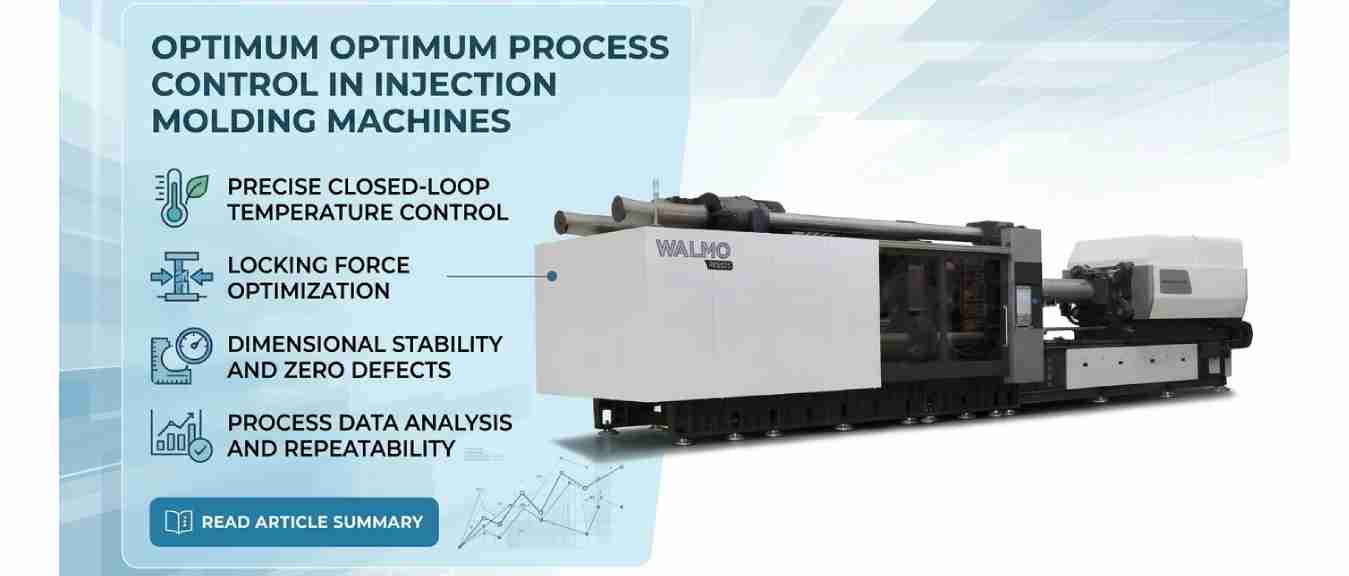
Optimal Process Control in Injection Molding Machines and Analysis of Parameters Affecting Quality
Abstract
Injection molding is one of the fundamental manufacturing methods that enables the high-precision, mass production of plastic parts with complex geometries. Achieving repeatability in the production process and the desired product quality depends on a delicate balance between mechanical variables, process variables, mold thermal equilibrium, and clamping mechanisms. In this study, the process dynamics in injection molding machines were examined; the effects of mold wall temperature and clamping/locking forces on the physical, mechanical, and dimensional properties of the final product were analyzed. Furthermore, the importance of closed-loop temperature control systems in ensuring process stability was emphasized.
1. Introduction
Achieving optimal production conditions in the plastic injection molding industry is not limited to simply adjusting machine parameters. Ensuring that molded products meet the targeted quality standards requires controlling a wide range of variables, ranging from the molecular structure of the raw material to thermodynamic changes within the mold.
Parameters in the injection molding process are generally categorized into two groups: machine-focused (mechanical) and process-focused (process). The success of the process depends on the consistent repeatability of machine-independent process variables and the proper management of thermal and mechanical balances within the mold.
2. Parameter Hierarchy in the Injection Molding Process
2.1. Mechanical and Process Variables
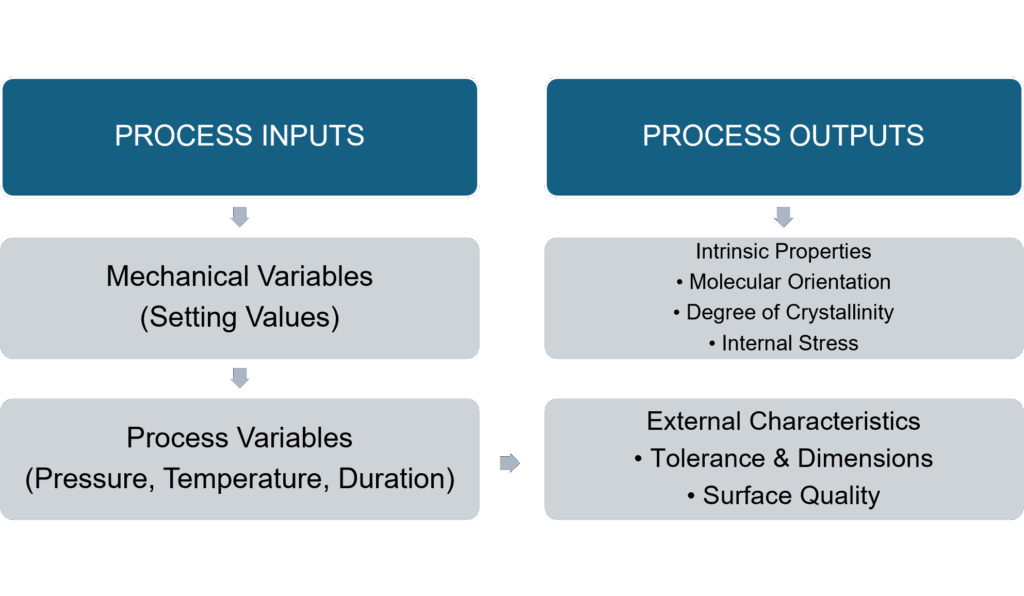
Mechanical variables are the setting values entered into the machine control unit to achieve the desired product characteristics. However, it is not possible to directly transfer mechanical variables one-to-one to another machine or to different product structures. Wear that occurs over time on the machine’s screw, screw tip, and hydraulic components alters the output of these settings.
Process variables, on the other hand, include the pressure, temperature, and time values of the molten material, as well as the temperature of the metal wall in the mold cavity. These variables, which are independent of the machine, are the key factors that ensure product quality is maintained even if production conditions are transferred to another facility or machine. Achieving products of the same quality depends on the repeatability of the process variables.
2.2. Product Characteristics and Process Monitoring
The properties of the manufactured part fall under two main categories:
- Internal Properties: These include structural characteristics such as the molecular weight of the raw material, its orientation, the distribution of additives, internal stress, and the degree of crystallization.
- External Properties: These include dimensional tolerances, geometry, surface smoothness, mechanical strength, and optical and electrical functionality.
Fluctuations in temperature and viscosity, dosing deviations, or screw tip movement errors are recorded as process data to ensure consistent product quality.
3. Thermal Equilibrium and Temperature Control in the Injection Mold
3.1. Thermal Transfers Within the Mold
In thermoplastic injection molding, continuous heat transfer occurs within the mold to enable the molten polymer to be shaped. The primary heat transfer mechanisms in this process are as follows:
- Heat transfer between the mold and the surrounding environment (radiation, conduction, convection),
- The amount of heat carried by the molten polymer entering the mold,
- Heat transferred via the coolant in the temperature control system.
3.2. The Effect of Mold Wall Temperature on Product Quality
Increasing or decreasing the surface temperature of the mold cavity directly affects the microstructure of the plastic material and its macro-scale performance.
- Positive Effects of Temperature Increase: The degree of crystallization and homogeneity increase, internal stresses and molecular orientation decrease, the amount of deformation/warpage in the product decreases, and the accuracy of reproducing mold details improves.
- Negative Effects of Increased Temperature: The cooling time increases (by approximately 2% for every 1°C increase), and molding shrinkage rises.
Since localized temperature variations can lead to uneven shrinkage and excessive internal stresses in the product, a uniform temperature distribution must be maintained across the mold surface.
3.3. Closed-Loop Cooling Systems
Traditional manually adjusted temperature controllers cause process instability due to line pressure fluctuations, changes in coolant temperature, and scale/deposit buildup in the channels. To prevent these issues, advanced cooling systems such as “micro-temp”—where the mold temperature is measured in real time using a thermocouple and flow control valves are managed using closed-loop logic—should be preferred.
4. Analysis of Clamping and Locking Forces
4.1. Force Definitions and Mechanics
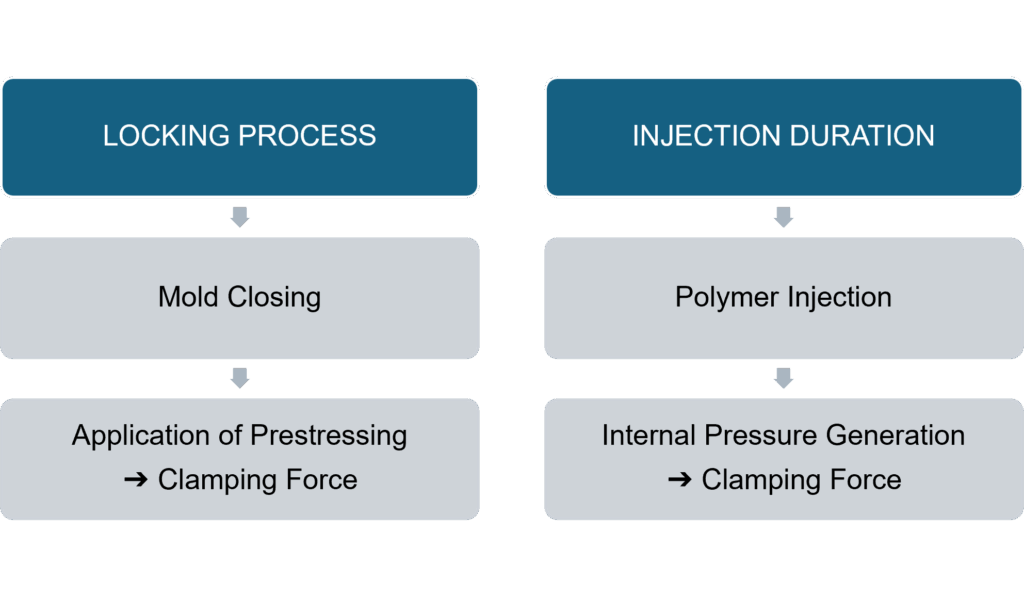
- Clamping Force: The sum of the pre-stress forces applied to the machine platen (column-type or columnless) before the mold closes and injection begins.
- Locking Force: The maximum force acting on the machine body due to the pressure generated by the molten material during injection.
These forces are calculated by considering the average pressure inside the mold and the projected area of the part. The mechanical rigidity of the mold and the applied forces directly determine the micro-deflections and dimensional stability that will occur during injection.
4.2. Consequences of Increased Clamping Force
Increasing the clamping force has both positive and negative effects on the mold and the product:
| Area of Effect | Effect of Increased Clamping Force |
| Dimensional Stability | Dimensional deviations in the product and variations in part dimensions are reduced. |
| Mold Integrity | Flash formation is prevented, thereby preventing mold dents and damage caused by flash. |
| Gas Venting | Ventilation within the mold cavity becomes more difficult, increasing the risk of gas entrapment. |
| Mechanical Wear | In toggle systems, the wear of connecting elements accelerates. |
| Energy Consumption | The amount of energy required to lock hydraulic systems increases. |
4.3. Residual Clamping Force and Measurement Methods
To prevent overfilling and mold damage, the residual clamping force on the mold parting surface must be maintained at a level of at least 10% of the total clamping force during production. Maintaining this ratio at a high level during the initial stages of mold trials is critical for process safety.
The measurement of clamping force varies depending on the machine type:
- Toggle Machines: Through tie-bar strain and closed-loop mold thickness adjustment,
- Hydraulic Machines: Calculated directly from the hydraulic pressure values in the system.
5. Conclusion
In the injection molding process, maximum efficiency and part quality are achieved not so much through machine settings as through the repeatable control of process variables. Controlling mold wall temperature with precise closed-loop systems minimizes mechanical and optical defects in the product, while the proper optimization of clamping and locking forces prevents flash formation and extends the life of the mold and machine.
Real-time monitoring, measurement, and analysis of process data are essential for achieving near-zero-defect quality in modern plastic injection molding.