

Injection Molding: Basic Principles and Systematic Mold Trial Procedures
Abstract
Achieving the goal of zero-defect production in the injection molding process depends not only on the optimization of process parameters but also on systematic preparation and disciplined equipment management. This study examines an integrated approach to mold preparation, material conditioning, and machine maintenance workflows and presents standard procedures aimed at improving operational efficiency.
Introduction
Plastic injection molding is a complex manufacturing method that requires high precision and repeatability. A significant portion of the quality losses and downtime encountered during the production process stems directly from a lack of pre-production checks and inadequate equipment management. To achieve systematic mold testing and sustainable production quality, it is essential to conduct integrated inspections of the mold, raw materials, and machine components.
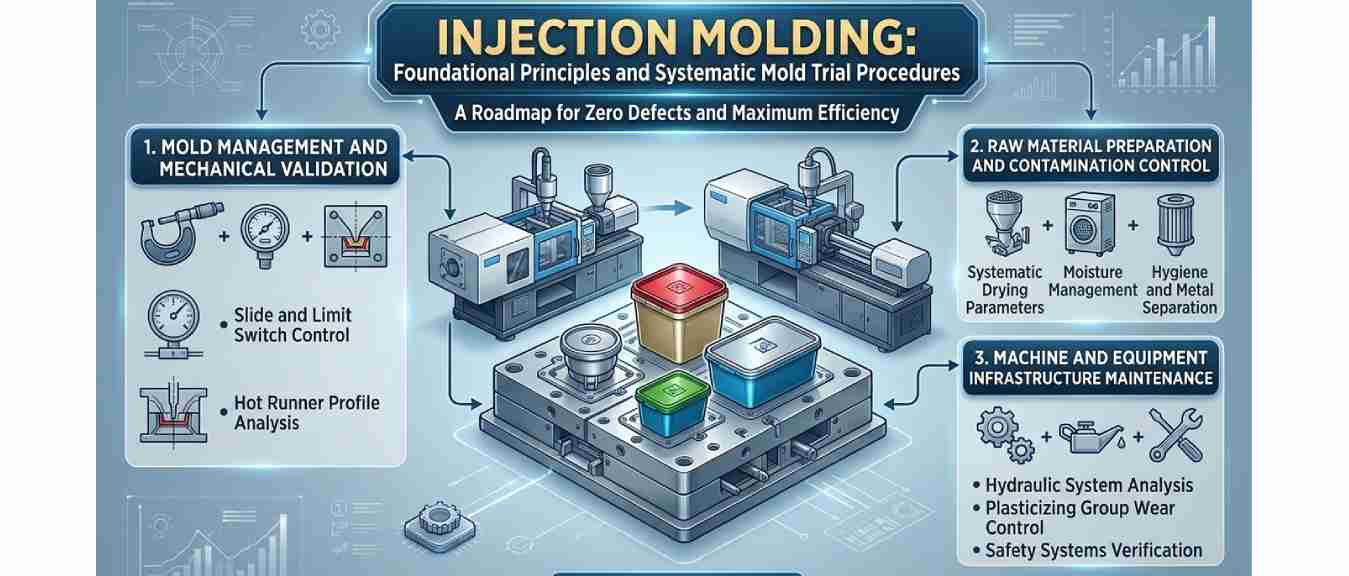
1. Mold Management and Mechanical Verification
Mold testing and the verification of the mold’s physical, mechanical, and thermal condition during the pre-production process are of critical importance. Mold management should be carried out in three basic stages: visual inspection, functional testing, and post-production maintenance.
Visual Inspection of Molds
For molds to be introduced into the production line, the following technical details must first be reviewed:
- Assembly Compatibility: The centering ring, sprue bushing (nozzle diameter), and ejector connections must be checked for compliance with machine specifications.
- Physical Condition: Check for damage on the mold parting surfaces and visible forming surfaces; ensure that the thermal insulation plates are fully installed.
- Operational Preparation: The date stamp must be updated, moving parts must be lubricated with appropriate grease, and secure fastening/clamping must be ensured.
Functional Inspection of the Die
After the mold is attached to the machine, the dynamic components must be tested:
- Mechanical Safety and Operation: The mold’s safety pressure and clearance must be optimized; the operation of the ejection mechanism, slides, and limit switches must be verified.
- Accessories and Fluid Lines: The tightness of thermostat and hydraulic pipe connections must be verified; cooling lines must be connected according to the correct diagram, and the adequacy of the thermostat’s output power must be checked.
- Hot Runner and First-Article Verification: Hot runner or heating hold temperature profiles must be defined; the first articles produced must be compared with the final product specifications.
Post-Production Mold Management
To preserve the mold’s service life and keep it ready for the next production run:
- Mold surfaces must be cleaned, treated with corrosion-inhibiting agents, and lubricated.
- If any damage is detected, a maintenance/repair request must be submitted.
- Before shutting off the thermostat, the fluid inside must be completely drained and the channels sealed; the last final product produced should be attached to the mold for reference.
2. Raw Material Preparation and Contamination Control
Inadequate hygiene in the injection molding machine, raw material feeding systems, and the surrounding environment causes contamination in the polymer material and the final product.
[Raw Material Receiving / Storage] ──> [Drying with Correct Parameters] ──> [Hopper / Feeding Control] ──> [Transfer to Cylinder]
- Hygiene and Cleaning Procedures: During material changes, the dryer, filter, and hopper must be thoroughly cleaned. Hoppers should be covered with lids, and magnets should be used to trap metal particles. The openings of opened material bags should be kept closed.
- Moisture Management and Conditioning: The drying process must be performed using parameters appropriate for the material specifications. Hygroscopic (highly moisture-absorbing) materials should not be exposed to a humid environment for extended periods after drying.
- Low Injection Volume Setting: When the injection volume is low, the amount of resin in the hopper should be reduced to minimize the material’s dwell time in the hopper and, consequently, prevent re-absorption of moisture.
3. Maintenance of Machinery and Equipment Infrastructure
Periodic maintenance of injection molding machines and peripheral equipment minimizes unexpected production downtime.
| Maintenance Area | Control Parameters and Operational Targets |
| Safety Systems | Periodic verification checks of safety doors, guards, limit switches, and position sensors. |
| Hydraulic System | Analysis of the operating oil’s temperature, level, cleanliness, kinematic viscosity, and metal content. |
| Lubrication Unit | Condition of the central lubrication system or machine housing/plate lubrication points. |
| Temperature and Heating | Temperature of the resin feed zone in the barrel, installation/stability of belt heaters, and functionality of temperature sensors. |
| Plasticizing Unit | Functionality of the non-return valve (screw tip) and detection of wear inside the barrel. |
| General Operation | General fluid leak checks on the machine and verification of the adequacy of the maximum clamping force (tonnage). |
Conclusion
Sustaining quality in the injection molding process depends on disciplined control mechanisms established across the mold, material, and machine triad. The implementation of standardized pre-inspection checklists and periodic maintenance procedures reduces the defect rate, extends equipment life, and ensures optimal production efficiency across the entire operation.