

A Comprehensive Comparative Analysis of Plastic Injection Molding Technologies: Electric, Hydraulic, and Hybrid Systems
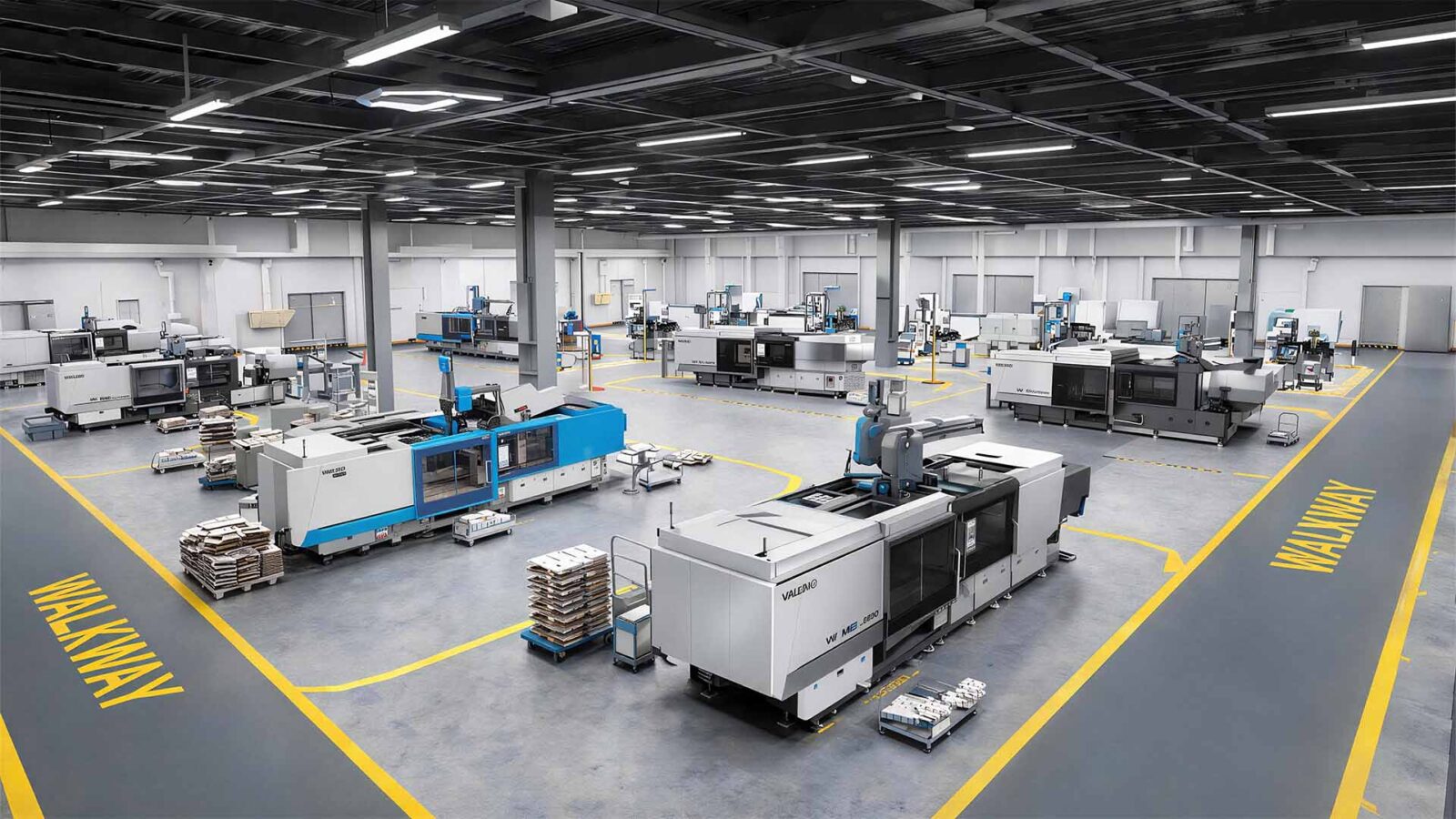
The plastic injection molding industry forms the backbone of modern manufacturing, offering high precision and mass production capabilities across a wide range of sectors, from the automotive and medical device industries to the appliance and packaging sectors. At the heart of this production ecosystem, injection molding machines perform the fundamental function of melting thermoplastic raw materials and injecting them into the mold cavity under high pressure.
However, industry standards that are constantly evolving, rising energy costs, and tolerances shrinking to the micron level have made it necessary to classify machines based on their drive systems. Today, injection molding machines are primarily categorized into three main architectures: Hydraulic, All-Electric (Servo-Motor-Driven), and Hybrid (Combined) systems.
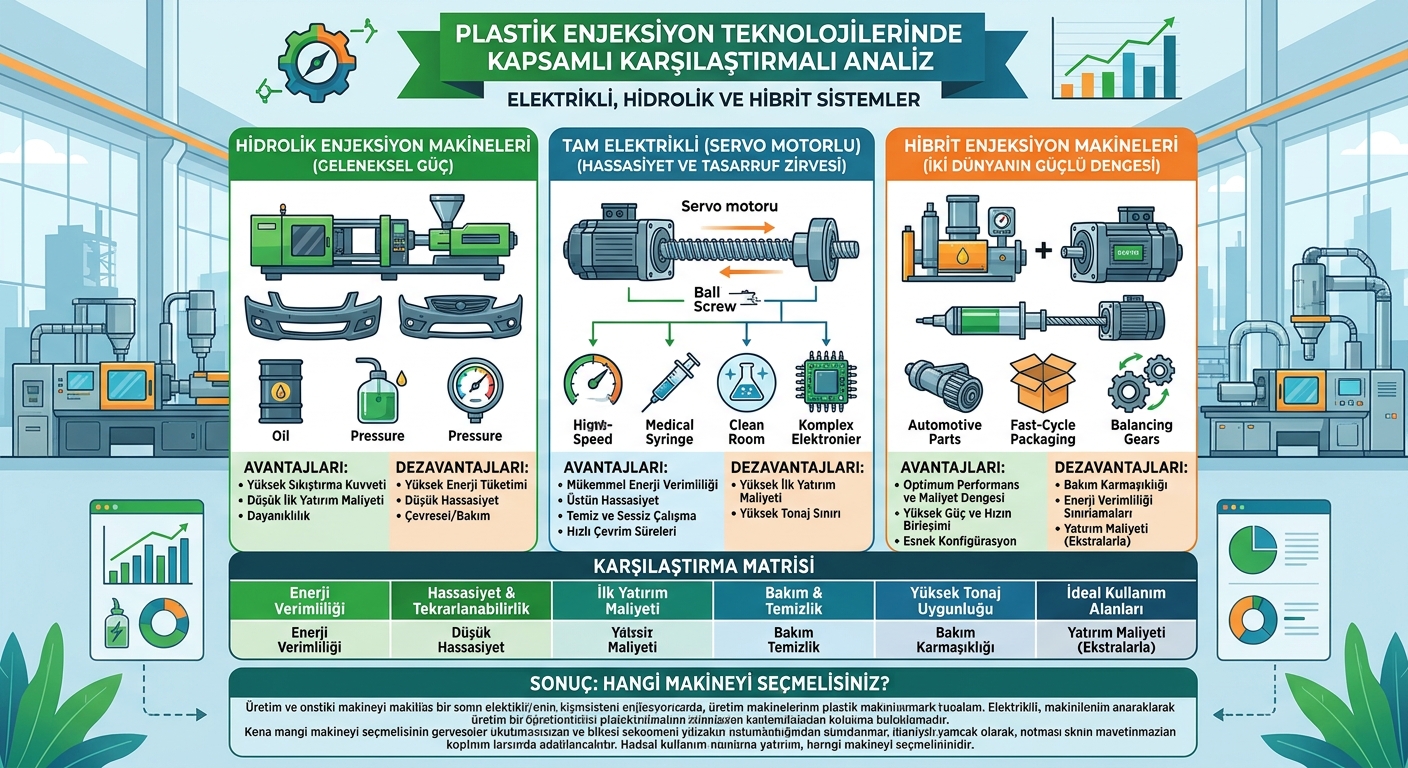
1. Hydraulic Injection Molding Machines: The Industry’s Traditional Workhorse
Hydraulic injection molding machines are the most established and widely used systems, performing all mechanical movements (clamp opening and closing, injection, part removal, and ejectors) via hydraulic pumps, valves, and pressurized fluid.
Operating Principle: Pressurized oil generated by an electric motor driving the hydraulic pump directs the hydraulic cylinders and motors, thereby moving the machine’s axes.
Advantages
- High Compression Force (Tonnage): Offers a cost advantage at very high tonnages (1,000 metric tons and above). It is the industry standard for large molds and bulky parts.
- Low Initial Investment Cost: The initial purchase cost is quite economical compared to electric and hybrid models.
- Durability and Easy Maintenance: It is resistant to heavy and demanding factory conditions. Spare parts are easy to find, and the technical service network is quite extensive.
Disadvantages
- High Energy Consumption: Energy consumption is high even when the pump is not running continuously—whether idling or under system load.
- Low Precision: Because fluid viscosity changes with oil temperature, it is at a disadvantage compared to electric pumps when it comes to micron-level precision.
- Environmental and Maintenance Disadvantages: There is a risk of hydraulic oil leakage; the working environment tends to be noisier and oilier.
2. Hybrid Injection Machines: A Powerful Balance of Two Worlds
Hybrid injection molding machines are hybrid architectures that combine the high power and dynamism of hydraulic systems with the speed and precision of electric systems.
Operating Principle: Axes requiring high precision and speed—such as injection and ejection—are typically driven by servo motors (electric), while high clamping force (clamp closure) and large-volume platen/core movements are supported by hydraulic accumulators or servo-pump systems.
Advantages
- Optimal Balance of Performance and Cost: Offers significantly higher energy efficiency and precision than pure hydraulic systems without exceeding the cost barrier of fully electric systems.
- Combination of High Power and Speed: It enables fast and dynamic injection even in molds with thick walls, large volumes, or those requiring high clamping force.
- Flexible Configuration: Allows for axis-based customization according to the manufacturer’s needs.
Disadvantages
- Maintenance Complexity: Since the system combines both servo motors/drives and hydraulic blocks/valves, it may require expertise in both systems.
- Energy Efficiency Limitations: In some configurations, the continuous operation of the pumps may result in energy efficiency that is slightly lower than that of all-electric models.
- Investment Cost: Due to added options and the hybrid design, the cost can even exceed that of all-electric injection molding machines.
3. Fully Electric (Servo-Motor-Driven) Injection Molding Machines: The Peak of Precision and Efficiency
In fully electric injection molding machines, the hydraulic system has been completely eliminated. Instead, axis movements are controlled by high-precision AC servo motors, lead screws (ball screw systems), and belt-and-pulley mechanisms.
Operating Principle: Each axis (clamping, injection, screw rotation, etc.) is directly driven by an independent servo motor via digital commands. Energy is consumed only during movement.
Advantages
- Excellent Energy Efficiency: They consume 50% to 70% less energy compared to hydraulic systems. They consume no energy during idle operation.
- Superior Precision and Repeatability: Positioning accuracy is at the micron level. This ensures the flawless production of medical parts, optical lenses, and thin-walled electronic components.
- Clean and Quiet Operation: Since no oil is used, they fully comply with food and medical standards and are suitable for cleanroom production. The operating environment is extremely quiet.
- Fast Cycle Times: Thanks to the axes’ ability to move simultaneously (parallel movements), cycle times are minimized to the greatest extent possible.
Disadvantages
- High Initial Investment Cost: The initial investment budget is high due to the technological infrastructure and servo motor costs.
- High Tonnage Limit: In very high-tonnage segments (e.g., over 1,600 metric tons), the cost and physical size of electric motors can create a disadvantage from an industrial perspective.
Comparison Matrix
| Criterion |
Hydraulic Injection |
Fully Electric Injection |
Hybrid Injection |
| Energy Efficiency |
Low / Medium (Constant pump load) |
Very High (50–70% savings) |
High (20–30% savings) |
| Accuracy & Repeatability |
Medium |
Excellent (Micron Level) |
Very High / High |
| Initial Investment Cost |
Economical / Low |
High |
Medium / High |
| Maintenance & Cleaning |
Risk of oil leaks, noisy |
Oil-free, clean, quiet |
Risk of oil leakage; requires partial hydraulic maintenance |
| High Tonnage Compatibility |
Excellent (ideal for 1,000+ metric tons) |
Limited / High-cost |
Very Good |
| Ideal Applications |
Thick parts, general-purpose plastics, high tonnage |
Medical, packaging, electronics, optics, precision parts |
Automotive, fast-paced packaging, medium-to-high tonnage |
Conclusion: Which Machine Should You Choose?
Choosing the right machine depends directly on the technical specifications of the part to be produced, the type of raw material, the investment budget, and the factory’s operational priorities:
- A Hydraulic Machine Should Be Chosen If: You are producing standard household items, simple thick-walled parts, or molds with very high tonnage (1,000 metric tons and above), and your initial investment budget is limited.
- An Electric Machine Should Be Chosen If: You are manufacturing medical consumables (such as syringes), thin-walled packaging, cell phone/electronic components, high-speed thin-walled lids, or technical parts requiring micron-level tolerances. Energy savings over the long term will quickly offset the initial investment cost.
- A Hybrid Machine Should Be Chosen If: You require high clamping force (a powerful clamping unit) but do not want to compromise on electrical speed and precision during the injection and dosing stages.