

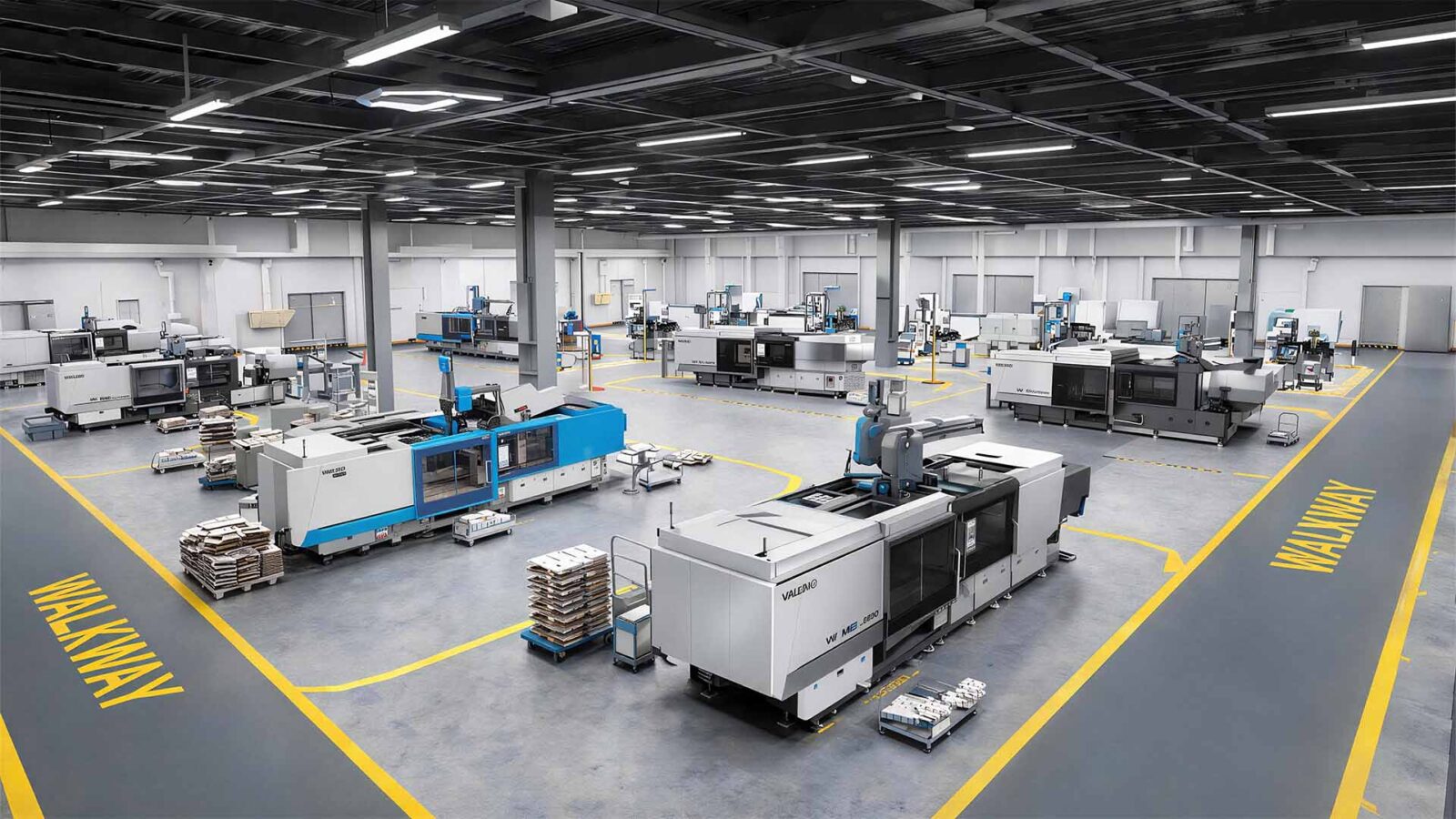
Plastic injection molds are steel or aluminum structures manufactured with high precision—to within a fraction of a millimeter—in which molten plastic raw material is shaped under high pressure to form the final product.
Let’s examine the basic characteristics, main components, and operating mechanism of these structures, which are considered the heart of the plastic injection molding industry.
1. Basic Characteristics of Plastic Injection Molds
A successful injection mold is not merely a metal block that gives the product its shape; it is also a thermal (cooling) and mechanical (motion) system.
- High Strength and Hardness: They are manufactured from high-quality tool steels (e.g., 1.2311, 1.2344, 2312) capable of withstanding injection pressures of thousands of bar and clamping forces of hundreds of metric tons.
- Precision Manufacturing Tolerances: Mold components are typically machined with micron-level precision (0.01 mm) using CNC, EDM (Electrical Discharge Machining), and grinding machines.
- Thermal Conductivity: The mold must have high heat transfer capability to ensure the plastic solidifies quickly within the mold.
- Surface Quality: The surface quality of the mold cavity determines whether the product emerges glossy, matte, or patterned (mirror polishing, sandblasting, texturing, etc.).
2. Main Structure and Components of an Injection Mold
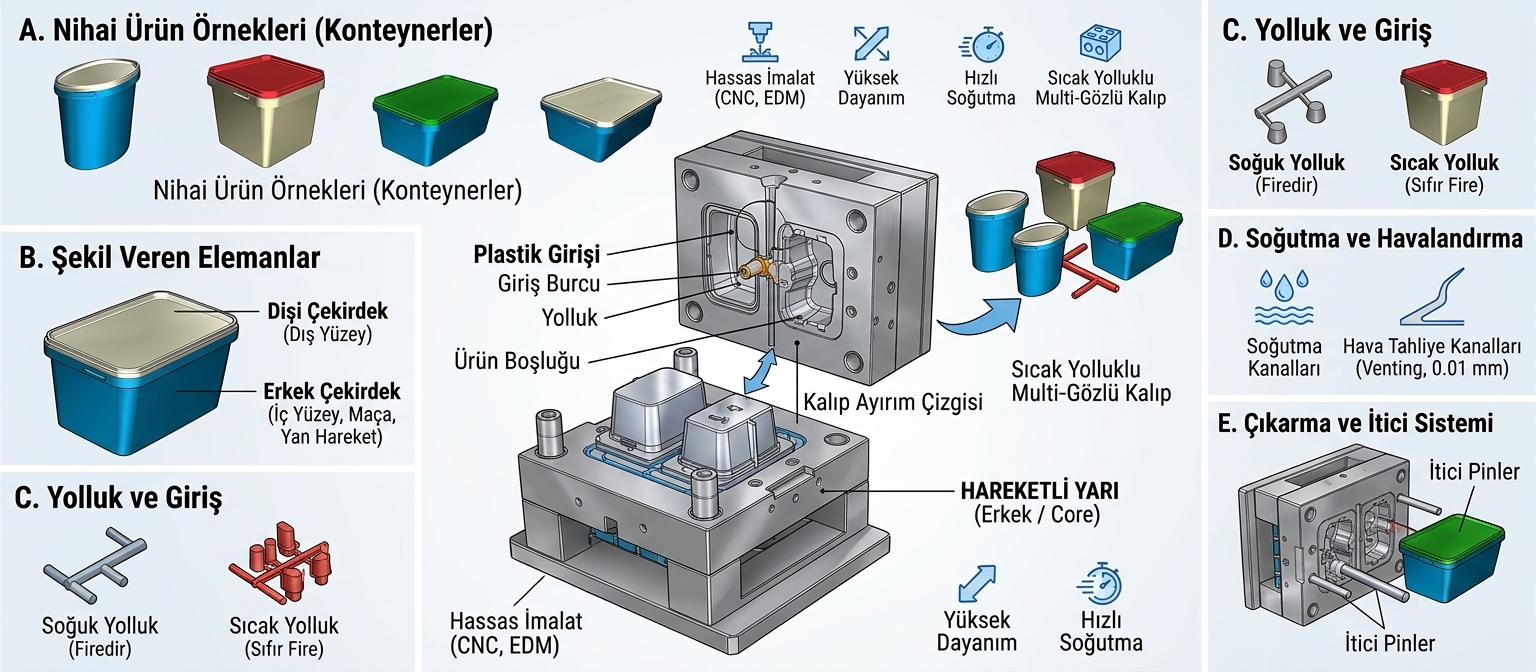
A plastic injection mold essentially consists of two main halves: the Fixed Half (Female / Cavity) and the Moving Half (Male / Core).
┌────────────────────────────────────────┐
│ FIXED HALF (Female / Cavity) │
├────────────────────────────────────────┤
Plastic Inlet ──►│ Inlet Bushing ──► Runner ──► Part │
└────────────────────────────────────────┘
════════ Mold Parting Line ════════
┌────────────────────────────────────────┐
│ MOVING HALF (Male / Core) │
├────────────────────────────────────────┤
│ Product Cores ──► Ejection System │
└────────────────────────────────────────┘
The main subsystems that make up the mold are as follows:
A. Mold Block and Plates
- Centering Bushings and Connecting Plates: Ensure the mold is securely mounted on the injection machine along the correct axis.
- Mold Base: Standard body plates that support all other components.
B. Forming Elements (Female and Male Cores)
- Female Side (Cavity): Typically located on the fixed plate, it defines the outer surface shape of the product.
- Male Side (Core): Located on the moving plate, it determines the product’s internal surface shape and wall thickness. When the mold opens, the product typically remains on this side.
C. Runner and Gate System
These are channels that carry molten plastic from the injection unit to the mold cavity.
- Cold Runner: The plastic solidifies in the runner channel and is ejected along with the product during each cycle (it can be recycled as scrap material).
- Hot Runner: The runner channel is kept constantly heated by heating elements. The material is injected directly into the product cavity without any material loss.
D. Cooling and Venting System
The cooling phase accounts for 60–70% of the injection cycle time.
- Cooling Channels: These are channels machined into the mold steel through which water or oil flows. They ensure uniform cooling of the product and prevent warping.
- Venting Channels: These are micro-channels (0.01–0.03 mm deep) that allow air trapped inside the part to escape as plastic fills the mold. If air is not vented, burn marks or incomplete filling may occur in the part.
E. Ejection System
This mechanism ensures that the cooled product is smoothly pushed out over the male core and drops out when the mold opens.
- Ejection Pins: These press against the hidden parts of the product to push it out.
- Ejector Plates: Used to remove circular or thin-walled parts without deforming them.
F. Core and Slider Systems
If the product to be manufactured has a threaded hole, a side hole, or an undercut, mechanical or hydraulic sliders that move perpendicular to the mold’s opening direction are used.
3. Classification by Mold Type
- Two-Plate Molds: The simplest and most common type of mold. It has a single parting line.
- Three-Plate Molds: Used in situations where the cold runner must be automatically separated from the product; there are two different opening planes.
- Hot Runner Molds: These systems are preferred for high-volume production runs (packaging, lids, etc.) as they reduce flash formation to zero.
- Multi-Cavity Molds: These are molds that produce multiple products (e.g., 4, 8, 16, or 32) in a single injection cycle.
Summary
A well-designed plastic injection mold ensures short cycle times, near-zero scrap, a long service life, and high product quality. Engineering excellence in mold manufacturing is the most critical factor directly determining unit cost on the production line and competitive advantage.