

Eliminating downtime in plastics machinery such as injection molding, extrusion, and blow molding requires a planned and systematic preventive maintenance strategy. Because plastics manufacturing occurs under high temperatures, high pressure, and continuous friction, unplanned downtime is extremely costly.
Below are the most effective preventive maintenance strategies grouped to completely prevent unexpected failures on plastics production lines:
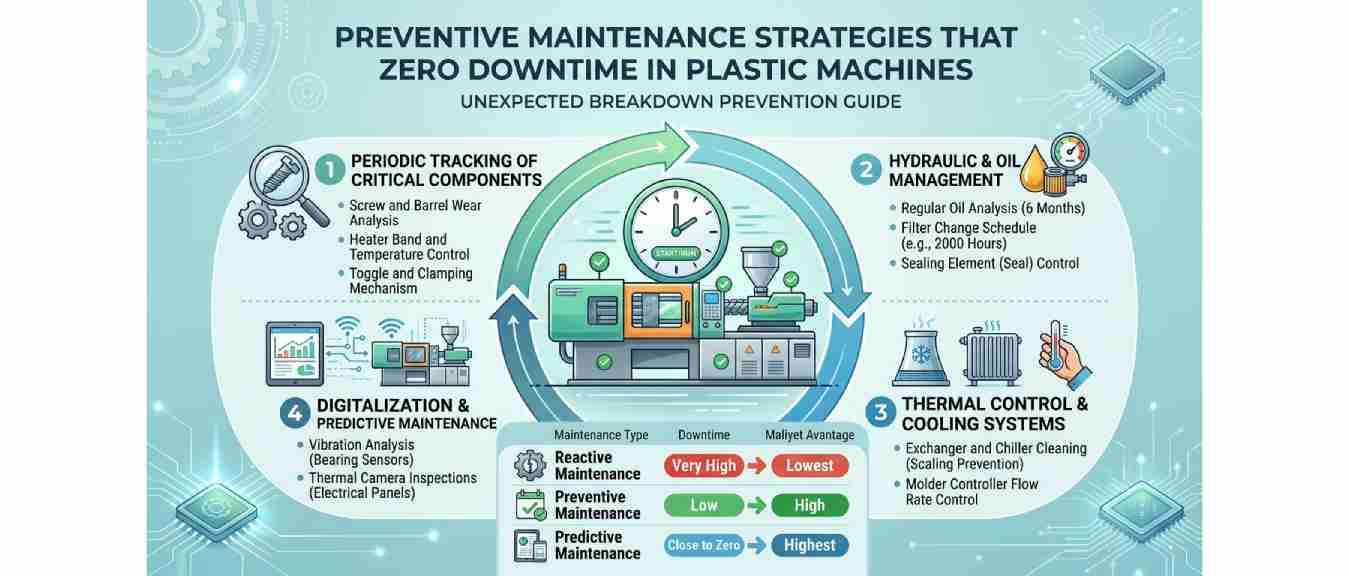
1. Periodic Tracking of Critical Components
Regular checks of mechanical and thermal parts—considered the heart of plastics machinery—prevent breakdowns before they even begin.
- Screw & Barrel Wear Analysis: Wear that occurs during the melting and conveying of raw material must be measured regularly. A worn screw degrades melt quality and strains the motor, leading to sudden shutdowns.
- Heater Bands & Temperature Control: Current and voltage values of the heating elements must be measured regularly. A faulty heater band can cause the plastic to freeze, resulting in the screw jamming and breaking.
- Toggle and Clamping Mechanisms: In injection molding machines, clearances and wear in the toggle systems that supply clamping force must be checked, and clamping force must be calibrated.
2. Hydraulics and Oil Management
Approximately 70% of failures in plastics machinery stem from hydraulic systems and oil contamination.
- Regular Oil Analysis: Oil viscosity, particle count, and water content should be tested at 6-month intervals.
- Filter Replacement Schedule: Hydraulic line and suction filters should be replaced based on operating hours (e.g., every 2,000 hours) without waiting for a clogging signal.
- Seals: Hydraulic cylinder seals operating under high pressure should be replaced during planned maintenance before they begin to leak.
3. Thermal Control and Cooling Systems
Temperature management in plastics processing is critical for both product quality and machine longevity.
- Heat Exchanger and Chiller Cleaning: Limescale in cooling water causes hydraulic oil to overheat. Overheated oil, in turn, causes hydraulic valves to stick. Heat exchangers must undergo periodic chemical flushing.
- Mold Temperature Controller Verification: Flow rates and pressure in mold cooling channels should be monitored to detect blockages in advance.
4. Digitalization and Predictive Maintenance
Taking preventive maintenance a step further, the most definitive way to eliminate downtime is to integrate predictive maintenance technologies.
- Vibration Analysis: Bearing sensors placed on main motors and hydraulic pumps detect abnormal vibrations, warning in advance before a motor bearing fails completely.
- Thermal Imaging Inspections: Electrical panels, terminal blocks, and heater connections are scanned with thermal cameras to prevent risks of fire or breaker trips caused by loose connections.
Comparison of Maintenance Types
| Maintenance Strategy |
Impact on Downtimes |
Cost Advantage |
Plannability |
| Reactive Maintenance (Intervention after breakdown) |
Very High Downtime |
Lowest (Heavy Losses) |
Unplannable |
| Preventive Maintenance (Calendar / Hour-Based) |
Low Downtime |
High |
Fully Planned |
| Predictive Maintenance (Sensor & Data-Driven) |
Near-Zero Downtime |
Highest |
Advanced Planning |