

From Petrochemical Dependence to the Circular Economy: New-Generation Sustainable Materials as Alternatives to Plastic
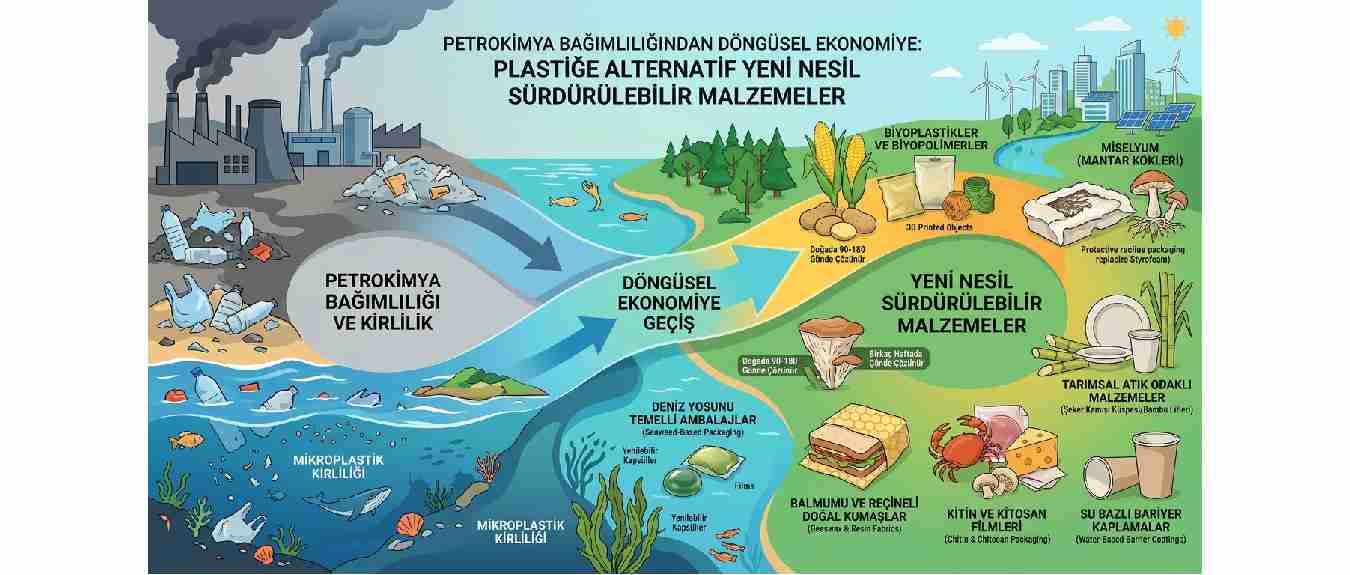
Dependence on petrochemical-derived plastics—one of today’s most pressing environmental crises—and the microplastic pollution it triggers continue to threaten ecosystems and human health. Developed as a solution to this global problem, these next-generation materials promise a fundamental transformation in the industry by building on the principles of the circular economy and biodegradability.
1. Leading Next-Generation Sustainable Materials for General Industrial Use
The most promising ecological alternatives to traditional plastics are designed using renewable resources and production processes that are in harmony with nature:
- Bioplastics and Biopolymers: This group, which eliminates dependence on fossil fuels, offers various advantages:
- Starch-Based Biopolymers: Derived from corn, potato, or wheat starch. Under suitable conditions, they are completely biodegradable in nature within 90 to 180 days.
- PLA (Polylactic Acid): A popular material produced from cornstarch or sugarcane that breaks down in industrial composting facilities. It is widely used in 3D printing technologies, food packaging, and single-use products.
- PHA (Polyhydroxyalkanoate): A microorganism-derived polymer produced by bacteria fermenting sugar or oil. It has the ability to completely degrade in nature—including in seawater—without leaving any harmful waste behind.
- Mycelium (Fungal Roots): This organic material, obtained by blending fungal roots with agricultural waste, is replacing foam plastics (Styrofoam) in the packaging industry. With its lightweight, durable, and fire-resistant properties, it has a wide range of applications, from protective packaging to insulation systems.
- Seaweed-Based Packaging: Gelatinous structures derived from fast-growing seaweeds—which require no farmland or freshwater—are replacing plastic films and sauce packets. This material, which decomposes in nature within a few weeks, is directly edible in some applications.
- Natural Fabrics Coated with Beeswax and Resin: These are produced by coating cotton fabrics with beeswax, jojoba oil, and tree resin. Replacing single-use plastics such as plastic wrap and freezer bags in kitchens, this material can be washed and reused, and when it reaches the end of its life, it breaks down harmlessly in nature.
- Agricultural Waste-Based Materials:
- Sugarcane Bagasse: Produced from the fibrous waste left over after sugar production; it offers a heat-resistant alternative to plastic plates and bowls.
- Bamboo Fibers: Fibers derived from fast-growing bamboo provide durable and biodegradable alternatives for plastic kitchenware and rigid containers.
Comparison of Traditional and Next-Generation Materials
| Material Type |
Time to Degrade in Nature |
Source Type |
Environmental Advantage / Status |
| Traditional Plastic |
400 – 1000 Years |
Fossil Fuel (Petroleum) |
Creates microplastic pollution; carbon-intensive. |
| Starch-Based Biopolymer |
90 – 180 Days |
Plant-Based Starch |
Rapidly soluble, leaves no microplastic residue. |
| Mycelium (Fungus) |
A Few Weeks |
Agricultural Waste + Fungi |
Fully compostable even in a home setting. |
| Seaweed |
4–6 Weeks |
Marine Ecosystem |
Acts as a carbon sink and can be converted into fertilizer. |
2. Revolutionary Solutions in the Food Packaging Industry
The food packaging industry ranks among the sectors with the highest plastic consumption and waste volume due to strict criteria such as food safety, shelf life, and leak-proofing. The most recent innovative solutions developed in this field are as follows:
- Edible Packaging: One of the most radical manifestations of the zero-waste philosophy.
- Seaweed Capsules (Notpla, etc.): These are biological membranes that trap water and liquids, can be swallowed directly, or dissolve in nature within a few weeks. They are replacing single-use plastic cups at marathons.
- Milk Protein (Casein) Films: Packaging produced from casein protein derived from milk is 50 times more effective than plastic at providing an oxygen barrier. Thanks to its ability to dissolve in hot water, it can be mixed directly into ready-to-eat foods.
- Smart and Antimicrobial Bioplastics: These are advanced-technology materials that delay food spoilage, thereby reducing both plastic use and food waste.
- Chitin and Chitosan Films: Derived from the waste of shellfish or fungi, this material prevents bacterial growth in meat, cheese, and fruits thanks to its natural antimicrobial properties.
- Bacterial Cellulose: A pure cellulose structure produced through fermentation; thanks to its flexibility, transparency, and high gas barrier properties, it replaces plastic barriers in oily and moist foods.
- Industrial Byproducts and Agricultural Waste: Packaging made by compressing sugarcane bagasse and barley/wheat straw fibers offers microwave safety, high-temperature resistance, and compostability.
- Enhanced PLA and Water-Based Barrier Coatings:
- CPLA (Crystallized PLA): This bioplastic, with enhanced heat resistance, is replacing petroleum-based plastics in coffee cup lids and hot food containers.
- Water-Based Barrier Coatings (Dispersion Coatings): Instead of a plastic (PE) layer used to ensure the leak-proofness of paper cups and cardboard boxes, plant-based, water-based coatings are applied, making the paper 100% recyclable.
Material Comparison Table for Food Packaging
| Material Technology |
Most Suitable Food Type |
Key Advantage |
Biggest Challenge Faced |
| Seaweed Membranes |
Liquids, sauces, beverages |
Edible, zero waste, dissolves within weeks |
Short shelf life, extreme sensitivity to moisture |
| Chitin/Chitosan Films |
Fresh meat, deli meats, cheese |
Delays bacterial growth and spoilage |
Cost of processing the raw material on an industrial scale |
| Sugarcane Bagasse |
Hot packaged meals |
Microwave-safe, high oil resistance |
Softening when left in liquid foods for a long time |
| Water-Based Coated Cardboard |
Coffee, soup, dry food |
Compatibility with standard paper recycling lines |
Leak-proof limit during very long-term liquid storage |
Result
The widespread adoption of sustainable materials on an industrial scale is a vital turning point in terms of reducing carbon emissions, protecting the oceans, and preventing microplastic pollution that threatens human health. The adoption of these innovations as industry standards will shape the future of global environmental policies.