

Features of Electric Injection Molding Machines – WALMO Injection and Molding Machine Division
Electric injection molding machines have been on the market since the 2000s and offer many advantages in their usage. Although hydraulic and hybrid injection molding machines are still widely used, many leading injection machine manufacturers focus primarily on producing electric injection molding machines. Especially due to the continuous advancement of technology and the very high production costs of high-tonnage machines, electric injection molding machines are becoming increasingly widespread. It is clear that the future of the industry lies in electric injection molding machines. There are five key reasons why molding with electric injection molding machines makes sense:
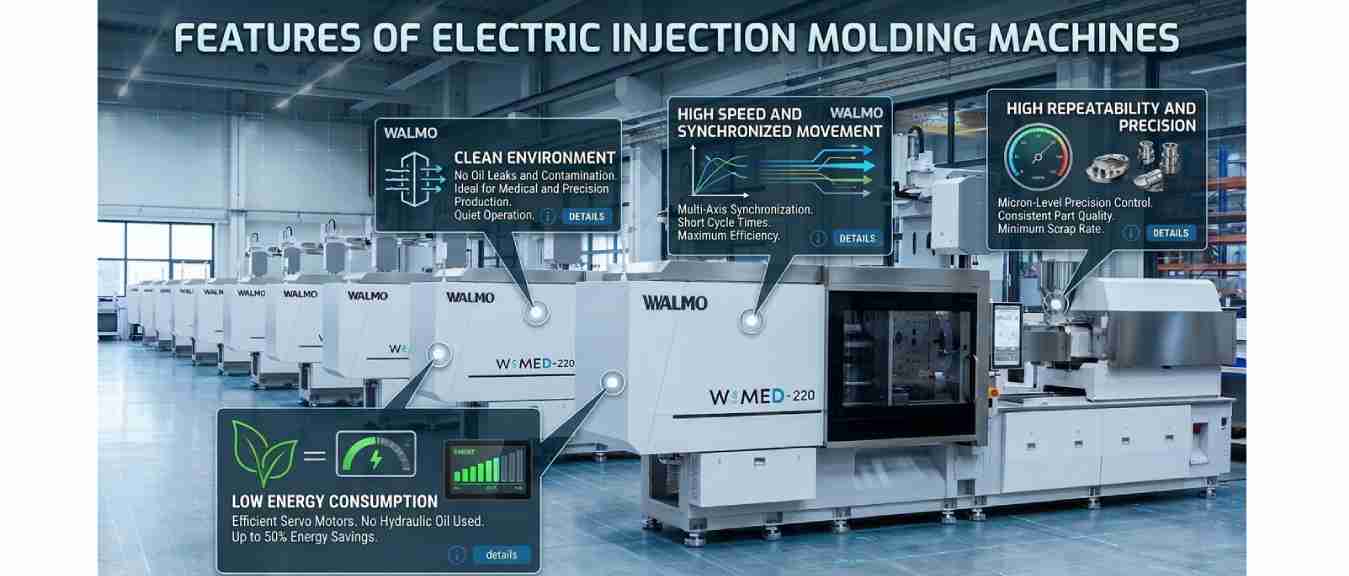
1. Cleanliness (No hydraulic oil; no oil leaks or spills on the floor)
No Oil Means No Contamination
Injection molding machines are divided into various types: hydraulic, hybrid, and electric. Typical hydraulic and hybrid machines require hydraulic oil to operate the clamping movement and the injection unit of the molding machine. Electric injection molding machines, on the other hand, perform all movements via servo electric motors without using any hydraulic oil. Because electric injection molding machines do not use oil, they carry no risk of oil leaks. Thus, your production floor remains free from dirty and slippery oil leaks, which pose a major safety hazard during mold changes. Furthermore, you are spared the hassle of changing hydraulic oil, which completes its lifespan after 2 to 5 years. The lifespan of the oil depends on whether the machine is operated 24/7 and whether the oil is kept at high temperatures that accelerate the degradation process. There is a huge difference between using and not using hydraulic oil. You never want your production floor to be exposed to and damaged by oil contamination; however, this poses a serious problem in industries requiring food packaging, medical part production, or clean rooms.
No Oil Changes Mean Less Maintenance
The lifespan of hydraulic oil in a machine largely depends on the duration of use and the quality of the machine. We have even encountered situations where hydraulic oil in a brand-new machine from a competitor became excessively contaminated within just 6 months of use. Consider the necessity of changing the oil every 6 to 12 months and the high oil costs in large machines that require approximately 2,000 extra liters of hydraulic oil. In our hybrid injection molding machines, we have witnessed some of our customers who regularly test hydraulic oil quality using the oil for more than 5 years. Still, please note that the manufacturer recommends replacing the hydraulic oil every 3 to 4 years depending on operating hours. The clean and quiet working environment provided by electric injection molding machines makes them ideal for businesses engaged in food packaging and medical part production. You do not need to worry about oil contamination when cleaning before a facility audit or feel anxious about the risk of sending contaminated parts to your customers.
2. Low Energy Consumption
Despite their name, electric injection molding machines are extremely energy efficient. When you compare typical hydraulic injection molding machines with electric injection molding machines for the same part and mold, you will see that 50% to 70% energy savings are achieved in most applications where electric machines are used. In a typical hydraulic injection molding machine, the hydraulic pump remains continuously active while the machine is running. It must continue running to circulate the oil and generates heat as long as the machine operates. On the other hand, an electric injection molding machine consumes electricity only when the servo motor rotates to provide movement; therefore, a large part of the production cycle is spent idle, which is particularly evident during the cooling phase of the cycle.
Electric Servo Motors
Typical hydraulic injection molding machines do not have one or more pumps that generate hydraulic pressure and valves that direct this pressure to hydraulic mechanisms to create pressure based on required movements. Electric injection molding machines do not have a central electric motor; instead, specifically designed separate electric motors are used for each function needed across the machine (mold opening/closing, injection, plasticization/backfill, and part ejection). This means that the motors can remain idle until their specific functions are needed. This makes as big a difference as night and day when compared to a typical hydraulic injection molding machine whose pumps must run continuously even when no operation is performed. This difference becomes especially pronounced during the cooling phase.
No Hydraulic Cooling Required
Energy savings are not limited to the injection machine alone. The elimination of the hydraulic pump circuit also eliminates the need to cool the hydraulic system. Since electric injection molding machines do not house hydraulic systems, they do not require machine cooling. Probably the only cooling process you will need will be for the mold and the feed throat. This provides additional savings since no extra water lines will be needed. While chilling units consume a large amount of electricity, cooling towers consume both water and electricity, and also require frequent maintenance and monthly water treatment processes.
Less Equipment Means Less Maintenance
It is common for customer facilities using only electric injection molding machines to typically house only chilling units. This is because they no longer need a high-temperature cooling circuit (~29-35°C) for their machines; instead, they require only a low-temperature cooling circuit (below ~27°C, usually ~13°C) for their molds and feed throats. Having less equipment naturally means less capital investment, lower maintenance and repair costs, lower energy consumption, and lower overhead expenses.
Facility-Wide Energy Saving
Electric injection molding machines operate at much lower temperatures because there is no heat generation caused by hydraulic pumps. Medical production and clean room facilities are typically climate-controlled environments; if the machine is electric, the air conditioning system does not have to work as hard to remove heat from the molding room environment. This is another reason why many medical product and clean room manufacturers prefer exclusively electric injection molding machines.
Consider Long-Term Savings
Considering all the aspects above, when a typical 350-ton hydraulic injection molding machine is compared with an electric injection molding machine, an electric machine saves approximately $15,000 per year. Although this figure represents a savings amount based on today’s conditions, this savings amount is expected to increase as energy costs worldwide tend to rise continuously. With proper maintenance and care, quality injection molding machines can offer a lifespan of over 20 years. This means that when evaluating a new injection molding machine, you need to account for the next 10 or even 20 years ahead. Make sure to purchase your new machines from a reputable and well-established company that manufactures its own components—such as platens, motors, sensors, circuit breakers, contactors, and cables. This way, you can always maintain access to spare parts.
3. High Repeatability and Precision (Closed-loop controls and linear movements)
Accuracy
Among the three types of molding machines, electric injection molding machines have the highest level of accuracy and repeatability. This is because these machines use electric servo motors operating with an accuracy of +/- 0.1 mm to provide their movements. This type of movement ensures the complete elimination of fluctuations in movements provided by hydraulic pressure and errors caused by inevitable pressure curves.
Consistency in Production
Typical hydraulic injection molding molding machines experience process variability continuously throughout the year and even during the day. This is because weather conditions change constantly and have an effect on machine temperature and humidity. As hydraulic oil cools, its viscosity increases, and as it warms up, it decreases. Moreover, the performance of hydraulic oil, which loses its properties over time, also changes. This means that the movement and lubrication pattern of the oil inside the machine will be completely different from the machine’s initial condition. It also means that your molding machine’s process settings may need to be readjusted periodically throughout the day. Typical hydraulic molding machine controls are considered “open-loop” because these systems send signals to valves to adjust pressure but do not have direct control over the physical movements of the machine; thus, they cannot perform all the minor adjustments that an electric machine can make in real time. Electric injection molding machines, on the other hand, are considered to have “closed-loop” controls because they control every movement through the physical gear rotations of their servo motors and have the ability to continuously monitor and control their position and speed with very tight tolerances independent of ambient conditions. This is the difference between “closed-loop” and “open-loop” controls. Electric injection molding machines are an excellent choice for the production of the most complex, demanding, and thin-walled parts. You can perform highly accurate injection operations while maintaining precise repeatability through day, night, and seasons.
4. High Speed & Simultaneous Movements
Electric injection molding machines feature multiple electric servo motors. These motors are connected to pulley and belt systems that drive lead screw mechanisms providing movement for functions such as clamp opening and closing. The ability of electric machines to perform compound movements (performing multiple functions at the same time) is one of the reasons why these machines generally shorten the cycle time compared to traditional and hybrid injection molding machines. You can eject parts before the mold is completely open (“ejection on the fly” process) and start the screw return (plasticization) process while the mold is opening and closing. Hydraulic injection molding machines, since they typically have a single hydraulic pressure circuit to provide movements, can generally perform only a single movement at a time. This makes a big difference for many mold makers switching to electric injection molding machines.
Instant Torque
We all know that the tremendous speeds of electric vehicles come from the instant torque provided by electric motors; the same applies to our electric injection molding machines. Thanks to our AC electric servo motors, instantaneous linear movements are achieved; with our high output power and high response time AC servo motors, injection speeds up to 800 mm/s and multi-stage injection speed profiles can be reached. Such high instantaneous torque also requires a very rigid and robust toggle locking mechanism. WALMO uses a highly rigid, 5-pivot toggle mechanism to ensure your machine continues to operate fast and reliably. To identify critical stress points on mechanisms, our platens and toggle systems have undergone extensive Finite Element Analysis (FEA) processes. All these practices are carried out to maximize the service life of our electric injection molding machines. We also use a very robust and precise lead screw mechanism to perform the clamping movement. As with any machine component, performance and quality levels can vary greatly; therefore, to fully understand performance reliability, it is important to inquire about which manufacturer’s lead screw is used in the injection machine.
5. Technological Advancements
Highly Reliable
Electric injection molding machines are the most reliable among different types of injection molding machines. This is because, unlike typical hydraulic and hybrid machines designed decades ago that generally appeal to lower price segments, electric machines generally utilize the most advanced technologies. Electric injection molding machines are quite quiet during operation; most operate at noise levels of 70 dB or lower. This means your employees do not need to wear hearing protection while operating the machines. You do not experience oil problems; you get a machine that requires less maintenance, has higher precision, higher repeatability, energy savings, a much quieter working environment, and is easier to maintain to ensure production continues uninterrupted.
Automatic Features
Electric injection molding machines do not experience valve sticking, oil quality degradation, process fluctuations due to ambient temperature, and noisy pump problems. Many electric machines feature standard safety features; examples include a mold safety system that prevents parts or foreign objects inside the mold from being crushed, and a “cold screw rotation prevention” feature that prevents the injection screw from being accidentally rotated while the machine is idling and the plastic is still cold and solid. Most machines feature a central or automatic lubrication system that automatically pumps grease to tie-bars, toggle linkages, linear guides, and other points requiring greasing. Thus, as long as the grease reservoir or cartridge is full, the machine automatically lubricates the areas requiring lubrication depending on the number of completed cycles. When grease levels drop, sensors in some machines alert your maintenance team to refill the grease or replace the cartridge.
Conclusion:
Many of our customers prefer Electric Injection Molding Machines for the following reasons:
- Ultimate level of cleanliness
- Very low energy consumption
- Very high repeatability and precision
- High-speed molding
- Technological advancements and features
For these reasons, electric molding machines are highly reliable for long-term production processes.