


Biodegradable Solution to Plastic Pollution: Next-Generation Polymer Developed in Japan Dissolves in Seawater Within Hours
Plastic pollution, which has become one of the most critical environmental challenges of our era, continues to threaten marine ecosystems and risk human health as microplastics enter the food chain. In response to traditional polymers that take centuries to decompose in nature, a groundbreaking step of global significance has come from Japan. Researchers at the RIKEN Center for Emergent Matter Science (RIKEN CEMS) and the University of Tokyo have developed a next-generation material that completely dissolves within hours upon contact with seawater.
Supramolecular Structure and Innovative Mechanism of Action
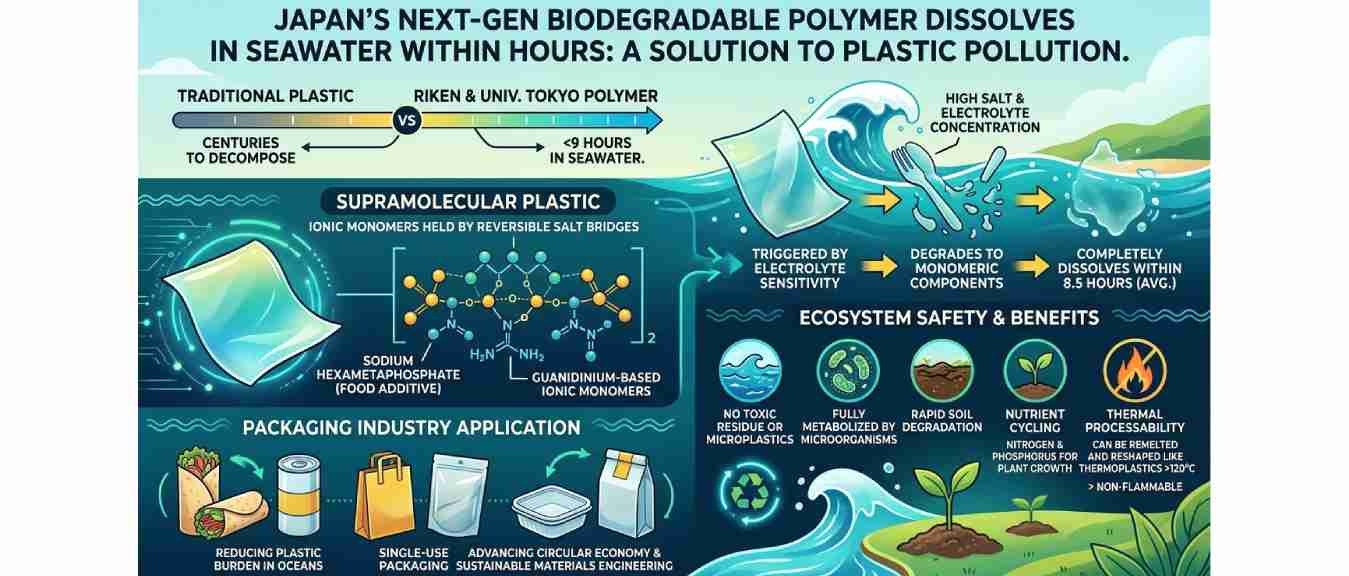
Unlike conventional petroleum-based plastics, this developed material is based on a “supramolecular plastic” architecture. Composed of ionic monomers held together by reversible salt bridges, this polymeric structure combines high mechanical strength with rapid biodegradability:
* Bio-Compatible Components: The synthesis of the material utilizes sodium hexametaphosphate, a common food additive, alongside guanidinium-based ionic monomers.
* Electrolyte Sensitivity: While exhibiting high stability equivalent to conventional plastics under terrestrial conditions and standard use, its chemical structure is triggered upon exposure to the high salt and electrolyte concentration of seawater.
* Rapid Degradation Process: Upon contact with a saltwater environment, the material completely dissolves within an average of 8.5 hours, breaking down into its monomeric components.
Ecosystem Safety and Contribution to the Circular Economy
The key feature distinguishing this breakthrough from existing bioplastic alternatives is that it leaves behind no toxic residue or microplastic particles after degradation. The components released as a result of dissolution can be fully metabolized by microorganisms in marine and terrestrial environments.
The prominent ecological and industrial advantages of the material are as follows:
* Compatibility with Soil Ecosystems: The product possesses the ability to dissolve rapidly in soil environments as well as in seawater.
* Nutrient Cycling Contribution: By releasing nitrogen and phosphorus into the soil during degradation, it provides a nourishing resource for plant growth.
* Thermal Processability: Alongside its flame-retardant (non-flammable) and non-toxic nature, it can be remelted and reshaped like standard thermoplastics at temperatures above 120°C.
Packaging Industry and Future Projections
Researchers anticipate that scaling this supramolecular material to commercial application—particularly in the single-use packaging sector—will significantly alleviate the plastic burden in the oceans. Achieving full environmental compatibility without compromising industrial functionality, this technology represents a turning point for circular economy goals and sustainable materials engineering.